All projects

03 / 08 App

Jiangtang

A self-hosted workspace for AV and facilities teams: rooms and equipment, event bookings, tickets, projects, tasks and notes in one place. EN/DE.
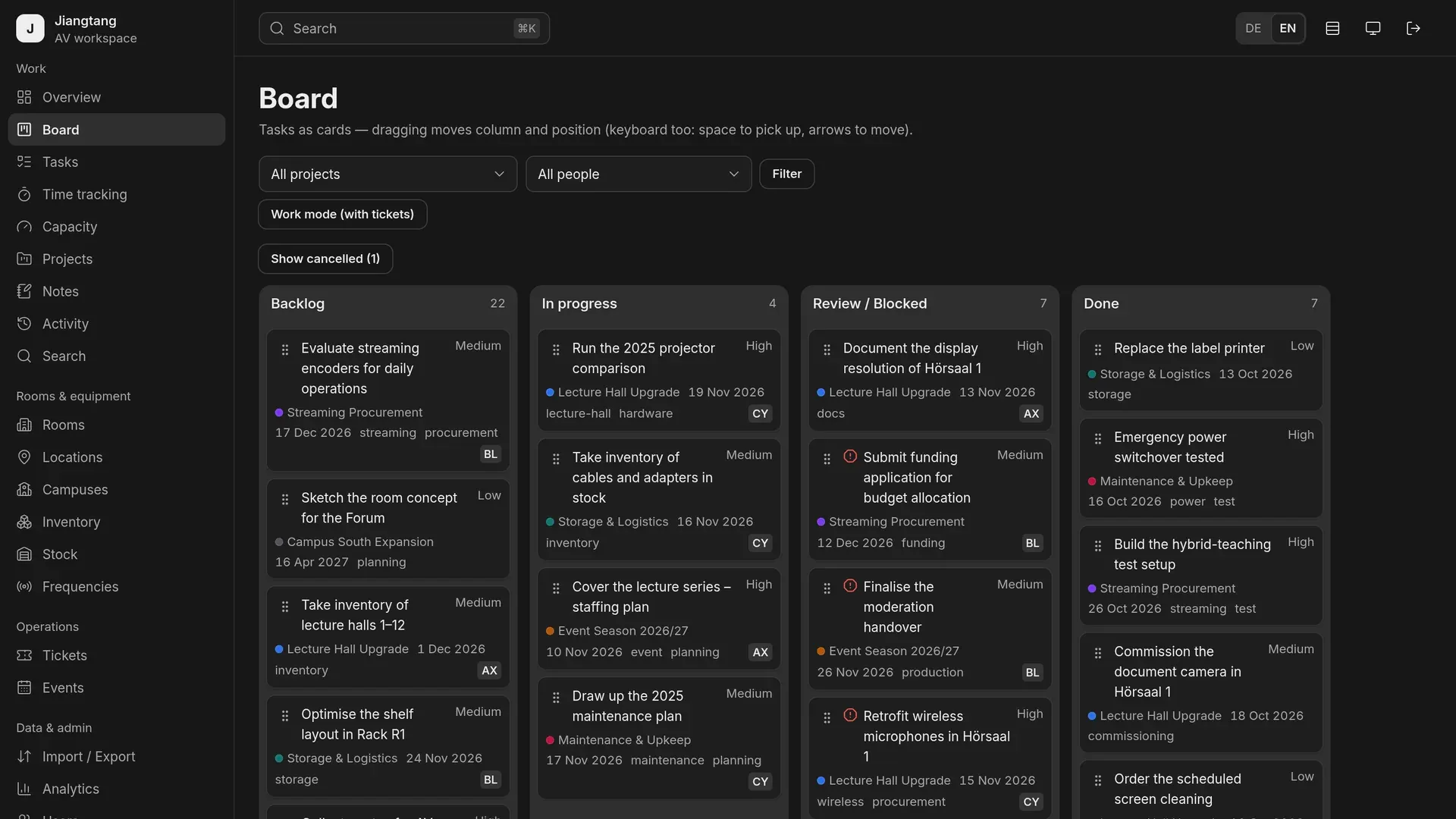
Jiangtang's task board in dark mode: Backlog, In progress, Review / Blocked and Done columns with cards such as "Run the 2025 projector comparison" and "Retrofit wireless microphones in Hörsaal 1", each showing its project, due date and assignee.
Screenshot
Status
Status: Open source (Apache-2.0) · stabilising
Platform
Web · self-hosted
Type
App
Built by
Caspar + AI agents

Jiangtang (讲堂) means "lecture hall". It pairs with Caotang: one is the quiet room where you write, the other is the busy room where the lectures happen, and the home of the team that keeps its projectors, microphones and cameras running.

It puts that team's day in one place: rooms and the equipment installed in them, stock, event bookings that the database refuses to double-book, tickets, projects with board, Gantt and burndown views, tasks on a kanban board with a dependency graph, Markdown notes, and a timesheet with capacity planning. Every change lands in an append-only activity history.

Search combines keyword and fuzzy matching across the workspace, and Ask answers from the workspace only, with a source for every statement. Generated answers need a model you configure yourself; without one, Ask returns the cited records. A mobile view at /m captures tickets, tasks and notes and queues them offline until the connection is back. Accounts are invitation-only, and the interface is in English and German.

There is no hosted service: you run it yourself on Node 22 and PostgreSQL 18 with pgvector and pg_trgm, with a Docker Compose stack for production. Jiangtang is open source under the Apache License 2.0 and currently in a stabilisation phase; bug reports and small, focused pull requests are welcome on GitHub.

Contact sheet

Real screens, demo workspace. Nothing staged.
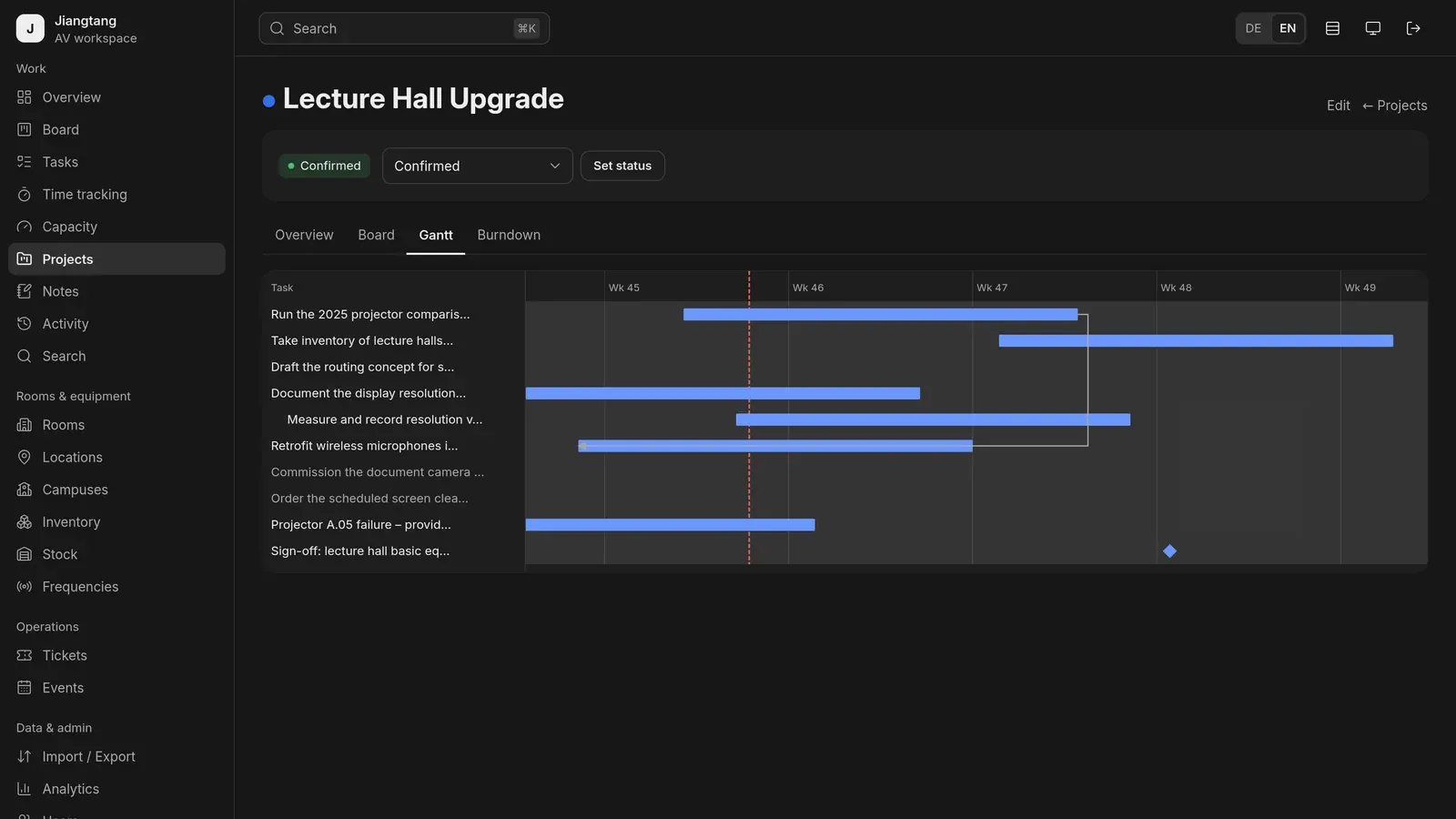
Jiangtang project Gantt for "Lecture Hall Upgrade": task bars across weeks 45 to 49, a dependency connector, a milestone diamond for the sign-off and a dashed red line for today.
Fig. 01 Board, Gantt and burndown all read the same tasks. Here, one project's Gantt.
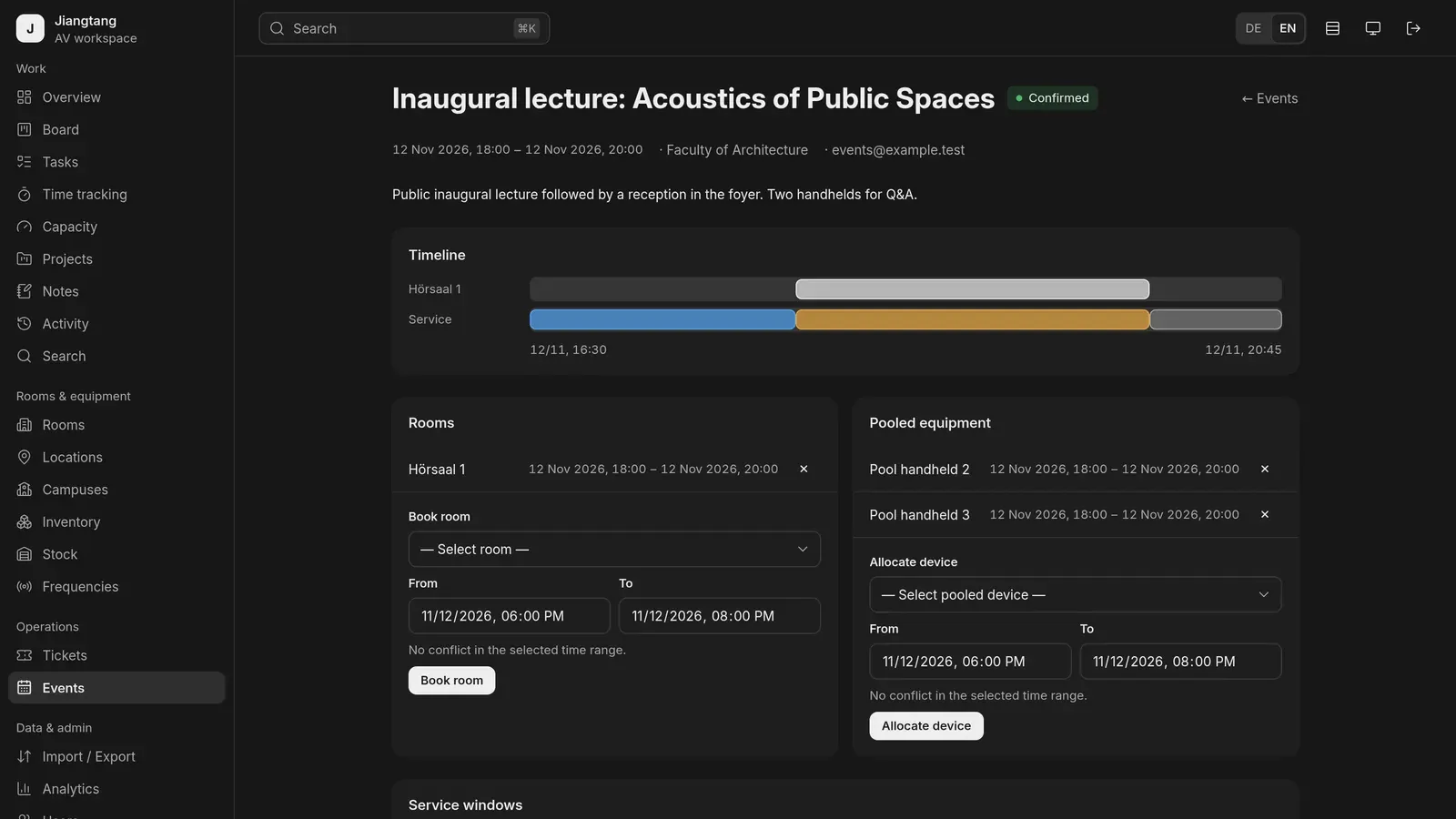
Jiangtang event "Inaugural lecture: Acoustics of Public Spaces": a timeline of the Hörsaal 1 booking with setup, standby and teardown windows, the booked room, two pooled handheld microphones and a "No conflict in the selected time range" check.
Fig. 02 Events book rooms and pooled kit. The database refuses a double booking.
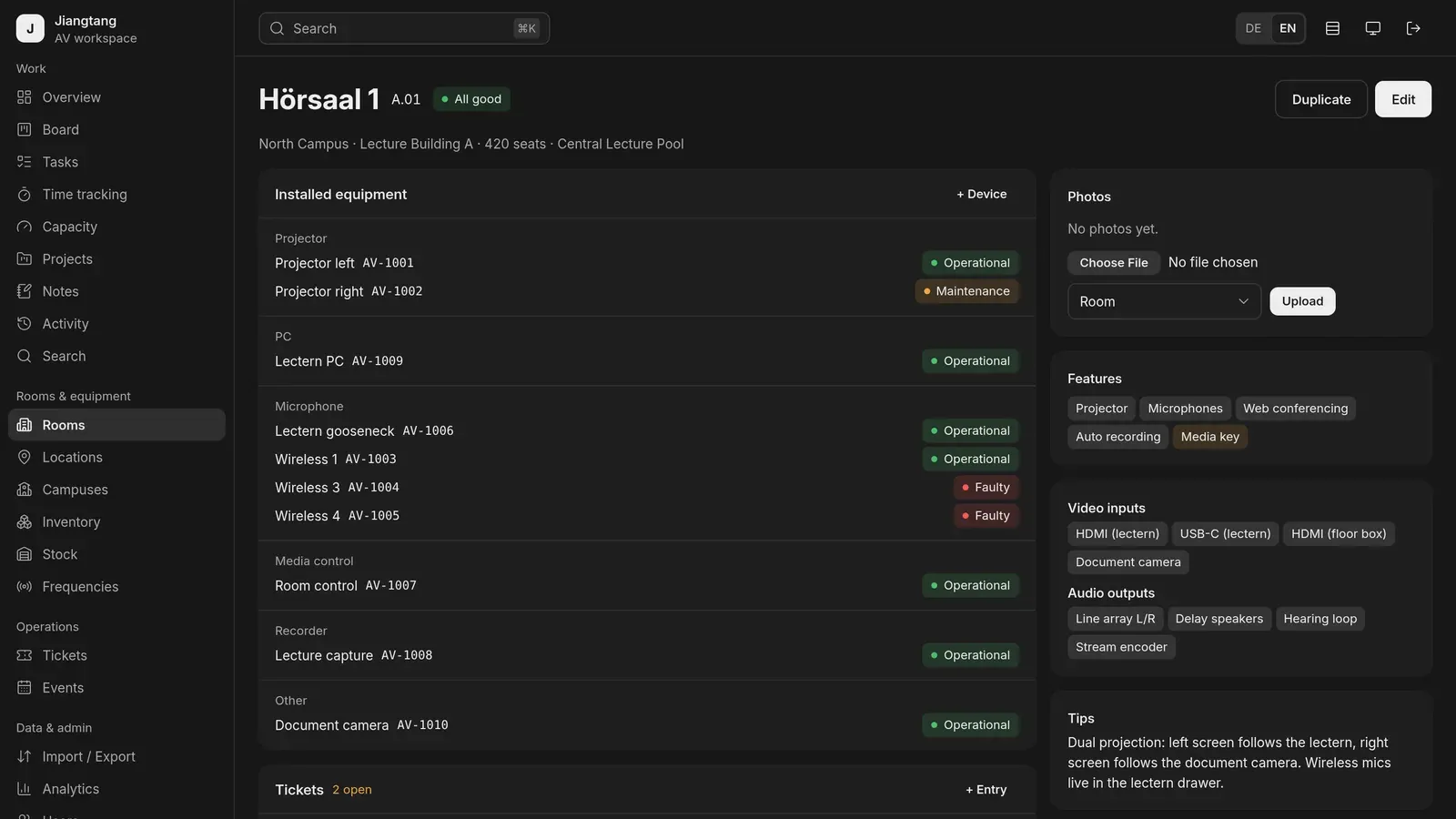
Jiangtang room page for Hörsaal 1: installed equipment grouped by type with asset tags and status (two wireless microphones marked faulty, one projector in maintenance), features, video inputs, audio outputs, tips and two open tickets.
Fig. 03 Every room knows its kit, its open tickets and its quirks.
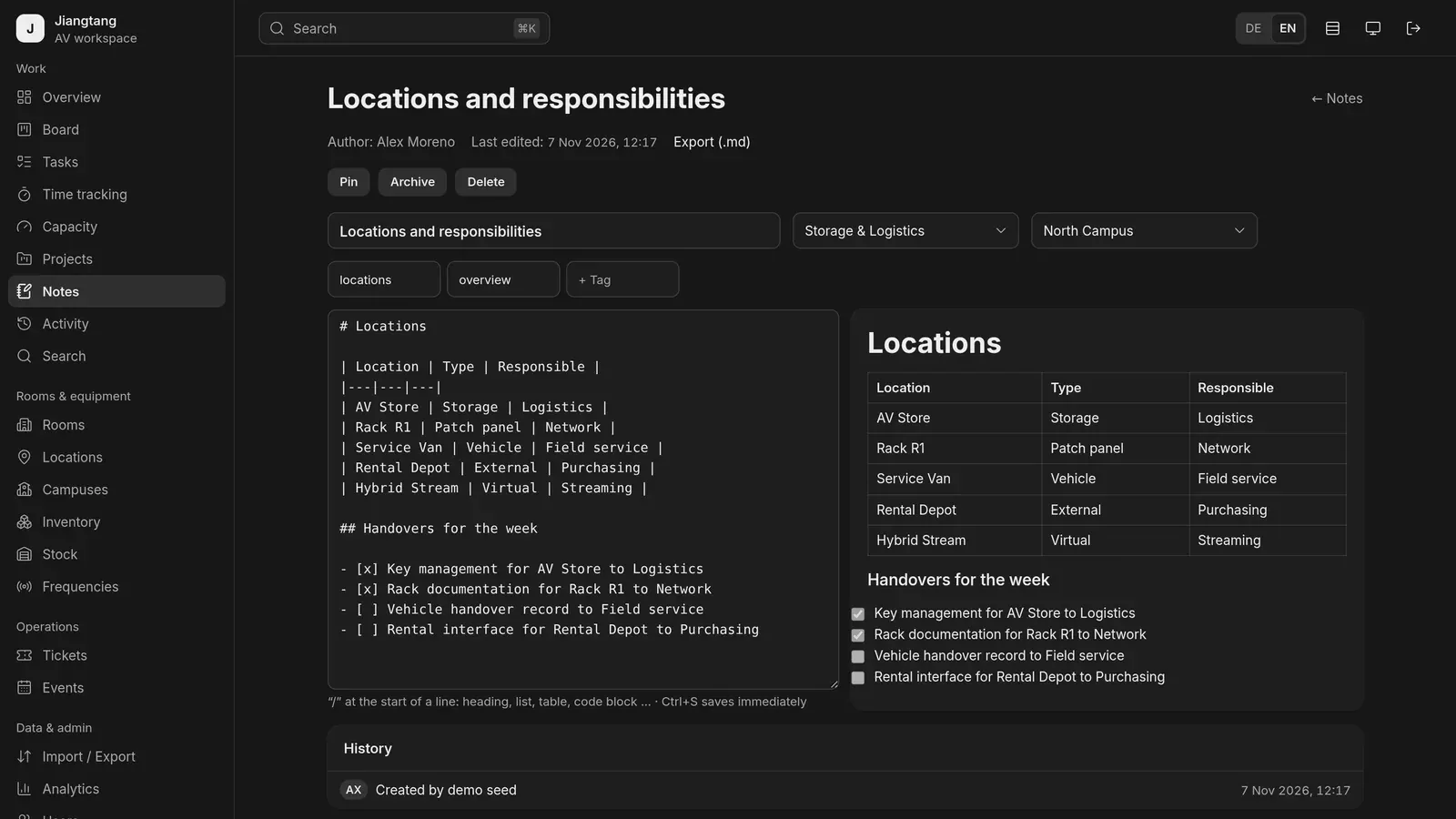
Jiangtang note "Locations and responsibilities": Markdown source on the left with a table and a task list, the rendered preview on the right, tags, a project and a location picker, and the note's history below.
Fig. 04 Markdown notes with a live preview, tied to projects and places.
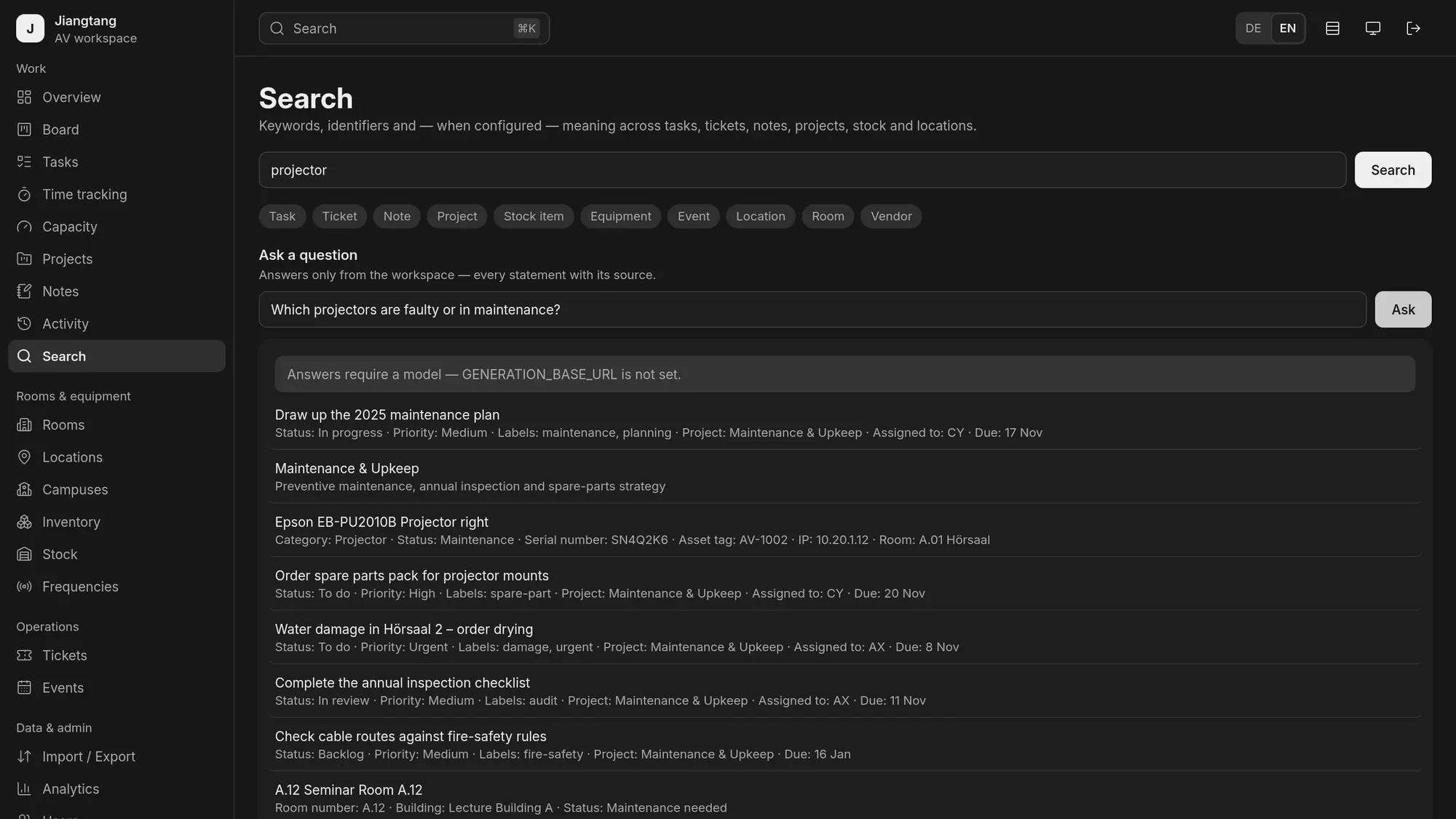
Jiangtang search page: the question "Which projectors are faulty or in maintenance?" answered with a list of cited records (tasks, a project and the projector "Epson EB-PU2010B Projector right"), with a note that generated answers need a configured model.
Fig. 05 Ask cites every record it uses. No model configured, so it shows the sources.
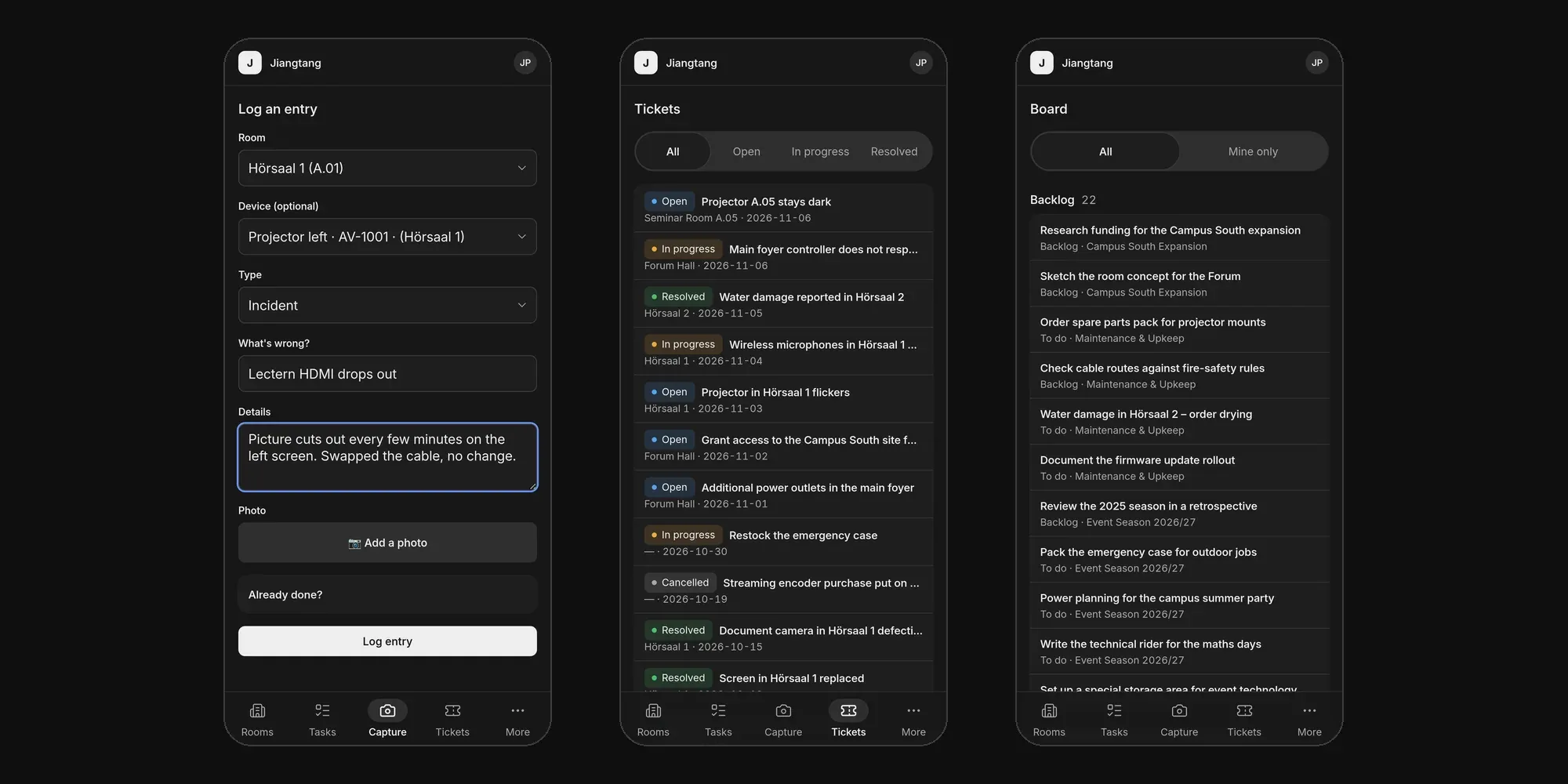
Three phone screens of Jiangtang's /m view: logging an incident for Hörsaal 1, the ticket list with status pills, and the read-only board.
Fig. 06 The /m view on a phone. Capture works offline and syncs once you are back online.